
Three Different Sanpete County Property Value Numbers
Three different numbers get called a value in Sanpete County. The Assessor sets valuation for taxation. A valuation notice gives the county's estimate for that tax year. A deed may state what a buyer paid. Those figures answer different questions. Before treating one as today's price, compare the purpose behind it and the date it carries, because a taxable value from last year and a fresh market estimate can sit far apart even on the same parcel card.
Assessed value is the tax-roll valuation; taxable value reflects applicable exemption treatment; sale consideration is a transaction figure stated in a deed. Keep each label and date attached to its number.
| Value type | Meaning | Where to look |
|---|---|---|
| Assessed value | Value used for the tax assessment | Assessor card or valuation notice |
| Market value estimate | Assessor estimate for a valuation date | Notice of Property Valuation and Tax Changes |
| Last-sale consideration | Amount disclosed in a recorded transfer, if shown | Deed or related transfer record |
| Taxable value | Amount after applicable tax treatment | Current tax-year Assessor or Treasurer record |
The Treasurer warns plainly that taxable value serves assessment purposes and may not match the office's own estimate of current market value. No public figure here replaces a private appraisal.
Find a Sanpete County Property Value and Keep Its Year
Search the parcel by address or APN in the county Account Search. Copy the value field exactly as the portal labels it. Keep its tax year too. Not every parcel card shows a last sale. It may also lack an improvement split, an exemption, or a comparison tool. A valuation question may need a missing field. Contact the Assessor about the parcel record.
- Locate the parcel in Account Search and confirm its legal description.
- Record the value field and tax year displayed on the card or notice.
- Check whether the figure is assessed, taxable, or another stated value.
- Use the deed index for a recorded sale amount when consideration is disclosed.
- Compare dates and parcel boundaries before interpreting a difference.
The county portal's About page says property information is current, except that taxable value is calculated for the current tax year. A number without its year loses meaning fast. Keep the field label attached too.
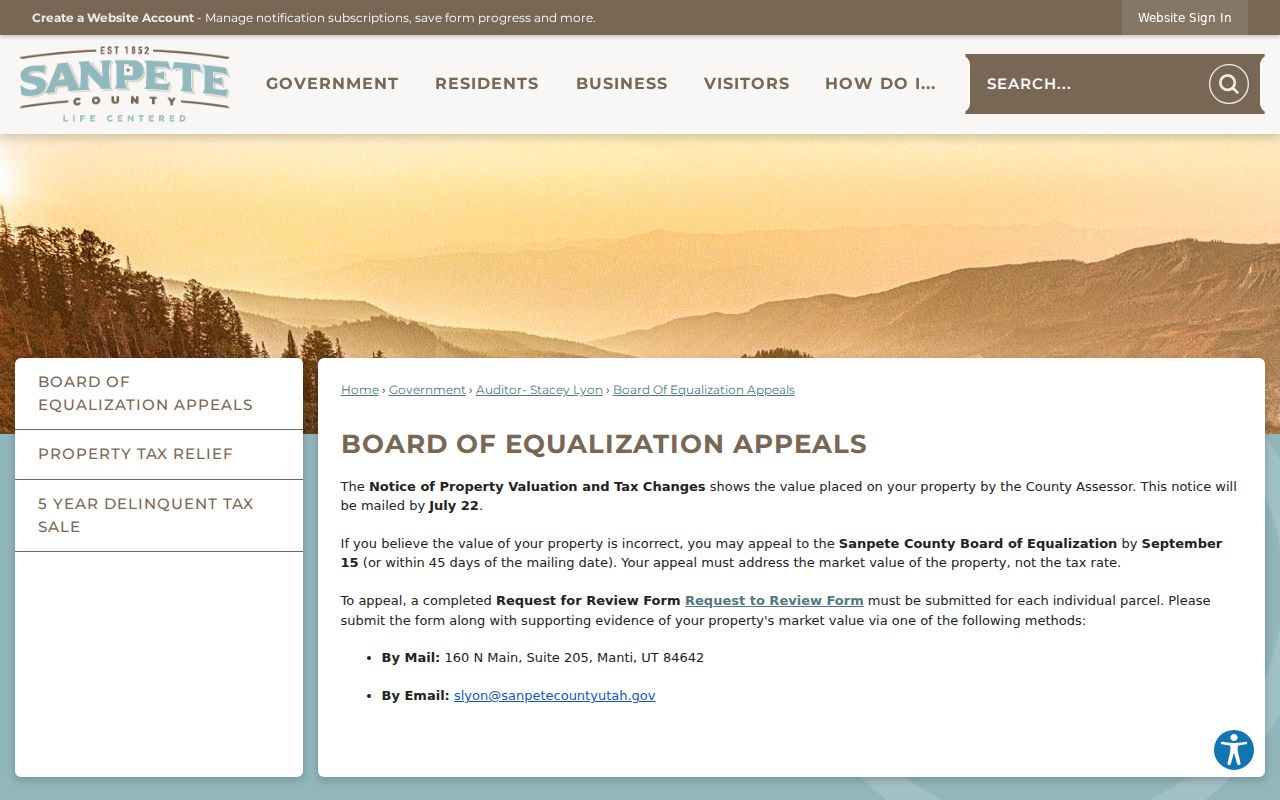
The county's Board of Equalization page explains valuation appeals.
Read the notice for the parcel and tax year. Treat a web value as a figure for its year, never as a current sale price.
Sanpete County Assessed Value and Utah’s Residential Ratio
Utah assesses ordinary residential property at 55 percent of fair market value. The residential exemption must apply for that ratio. That ratio is an assessment basis. It is not a discount promising a particular tax bill. Qualifying primary-residence treatment can change the taxable basis. So can agricultural or greenbelt treatment. Confirm the parcel's treatment with the Assessor. Keep any exemption field separate from a market estimate before comparing Sanpete County values.
Land and improvements may also be valued separately. A rural tract, a historic Manti town lot, and a newer Ephraim edge parcel are not natural comparables. Before reading a gap between two cards, weigh acreage, lot shape, access, utility service, and building condition. Weigh the value year too.
Why the Last Sale Changes a Sanpete County Property Value Comparison
A sale date and an assessment date can sit months apart. Not every deed reflects open-market terms. A family transfer, a nominal deed, or an estate conveyance makes a weak comparable. Some deeds omit consideration or state only a nominal amount. Exemptions can move taxable value. A parcel split can leave a recorded sale and the current tax card describing different land.
Read the deed image and its legal description first. A transfer tax stamp will not say what the figure means. Neither will a short index row. The Recorder's index is parcel-linked from March 8, 1988. Older material may take book or archive research.
Sanpete County Property Value Trends Are Not an Appraisal
Countywide trends are context, never a substitute for parcel analysis. Ephraim notices point to growth at North Meadows, The Crossing, Cedar Point, and Hawks Landing. Manti comparisons should separate historic-core lots from newer edge parcels. Mount Pleasant's town grid and county boundary both need care. These differences shape the choice of comparables. Land and improvement comparables must make sense for a Sanpete County property value question.
No city median is guaranteed here. Nor does trend context supply a parcel-level market estimate. For one property, align the sale date, tax year, legal description, acreage, and improvements. A value card alone omits features a market comparison needs.
Check the Sanpete County Property Value Taxable-Value Caveat
The Treasurer portal states that indicated taxable values serve assessment purposes and may or may not reflect the office's estimate of current market value. Assessment records belong to the Assessor. The Treasurer adds tax lookup and payment. Neither portal works as an appraisal service.
A tax payment screen shows what is due for the account and year chosen. It will not confirm title, an open-market sale value, or an exemption beyond that record. Check the APN and year before paying.
Sanpete County Property Value, Tax, and Appeal Questions
Value notices and appeals live inside the tax assessment record. Sanpete County's Board of Equalization sets the window: September 15, or 45 days from the notice mailing date. That deadline is firm. File late and the county will not hear the case.
Evidence carries the appeal. Comparable sales help. So do photos, repair records, a survey or plat, and proof that the parcel characteristics on file are simply wrong. Match each document to the notice.
Frame the appeal around the notice's own parcel facts. Acreage counts. So do improvement details, access, and land classification, because each one feeds the Assessor's figure. A comparable sale only persuades when it is tied to its date and land description; a new subdivision lot, an agricultural tract, and a historic town parcel are not equivalent evidence. Keep photos, repair estimates, survey or plat material, and comparable-sale documents with the notice so the county can see which recorded facts the evidence addresses. For filing steps and notice timing, the Sanpete property-tax record guide and the county appeal page are the primary sources.
Note: an appeal changes no deed and creates no title conclusion. Keep the value year, mailing date, parcel number, and evidence in one file.
Recorded Sales in a Sanpete County Property Value Comparison
The Recorder holds Sanpete County's conveyances. A deed may disclose consideration or point to a transfer record. The public index works as a catalog. Account access may be needed for full images and expanded data. The Assessor card can lag a fresh transfer. The Recorder's duty to report changes carries no promised refresh date.
Record the deed instrument number and its date. Then verify the legal description against the parcel being valued. An encumbrance, corrective deed, or family transfer is not an arm's-length sale without evidence. If the sale amount is missing, never back-calculate one from the taxable value.
What a Sanpete County Property Value Does Not Tell You
An assessed value exists for taxation. It does not predict what a Sanpete County parcel will sell for. A public value can be dated, shaped by exemptions, or built on parcel details that have since changed. That is not an appraisal. It settles nothing about condition, title, or boundaries.
Value is not a sale promise. Keep the tax year and field label with every number. Use an independent qualified appraiser for a market-value opinion and the county notice for the assessment record.
Sanpete County uses September 15 as the appeal filing deadline. It also allows 45 days after the notice mailing. Check the parcel and mailing date first. Then offer evidence about that property, not a countywide average.
Tie every exhibit to the right tax year and parcel boundaries. A later split, a new improvement, or a changed exemption can make a comparison stale. Two similar addresses prove nothing.