
Which Sanpete County Deed Records Change an Ownership Record
A deed filed in Sanpete County records the transfer of an interest in land. The index helps you spot the parties and the recorded instrument. It cannot settle every title question on its own. The deed itself carries the legal description and the terms of the conveyance. Before treating a result as a sale, identify the document type. Check its parcel against the Assessor record. Watch for a later corrective deed or release.
| Instrument | What it generally records | Useful reading clue |
|---|---|---|
| Warranty deed | Conveyance with the warranties stated in the instrument | Read the grantor, grantee, legal description, and covenants |
| Quitclaim deed | Transfer of whatever interest the grantor holds | Do not treat it as proof of full title by itself |
| Trustee or personal-representative deed | Conveyance by a fiduciary or estate representative | Related trust or probate records may explain authority |
| Beneficiary or tax deed | A special transfer path stated by the document | Confirm the legal process and later recordings |
| Easement or right-of-way | A use interest affecting land | It usually does not change the fee owner |
The Recorder's index holds more than deeds. Mortgages, deeds of trust, assignments, reconveyances, and liens sit in the same records. A loan instrument may be recorded between two deeds. That does not change who owns the fee interest. Read each entry by type before assuming a transfer occurred.
Sanpete County Deed Records in the Grantor-Grantee Index
Every deed entry pairs a grantor with a grantee. The grantor conveys the interest. The grantee receives it. To confirm a recent transfer, search the current owner as grantee and pick out the newest deed. Then run the prior grantor as grantee to locate that party's own acquisition. Keep going by date and legal description. The index supports this chain-step method itself; EagleWeb offers no dedicated reverse-chain button, so the work is done entry by entry.
- Start with the parcel number or the owner shown on the Assessor tax roll.
- Search that owner as grantee and find the most recent conveyance matching the land.
- Record grantor, grantee, recording date, document number, instrument type, and legal description.
- Search the grantor as grantee in an earlier date range, confirming the same legal description.
- Repeat until the parcel splits, the description changes, or the online index reaches its start date.
Names are not always simple in the grantor-grantee index. An owner may be an LLC, a trust, or an estate, so search the exact name and any punctuation variants you know of. A fiduciary can show up under an individual name and under an entity form. When the summary row leaves the parties unclear, compare the instrument images themselves.
Coverage of Sanpete County Deed Records and Earlier Volumes
Online boundary. The parcel-linked electronic deed index reaches back to March 8, 1988. That date is a digital-search cutoff, not the birth of Sanpete County land records. Research before it moves to Recorder books, grantor and grantee volumes, microfilm, vault material, and archival finding aids. The free Public Web Limited Viewer offers a basic index and property search. Full-resolution images and expanded data require an account, and payment or a subscription may apply. Treat the portal as a catalog, and try spelling variants as it suggests.
For an earlier conveyance, ask the Recorder about deed books, microfilm, or vault material. Utah State Archives series inventories list Sanpete County deeds and general filing indexes. They also cover land patents, mortgages, plat maps, subdivision maps, tax-sale records, and probate indexes. FamilySearch carries selected Utah State Archives material from 1848 to 2001. Coverage varies by county and record type. An index entry or digitized map is only a lead, never a certified deed copy.
Grantor and grantee: the grantor conveys an interest; the grantee receives it. A deed’s legal description identifies the land, while the instrument type and terms define what interest moved.
Online boundary. The parcel-linked electronic deed index reaches back to March 8, 1988. Ownership research before that line turns to Recorder books, microfilm, vault material, and archival finding aids.
The Public Web Limited Viewer is the Sanpete Recorder’s index entry point.
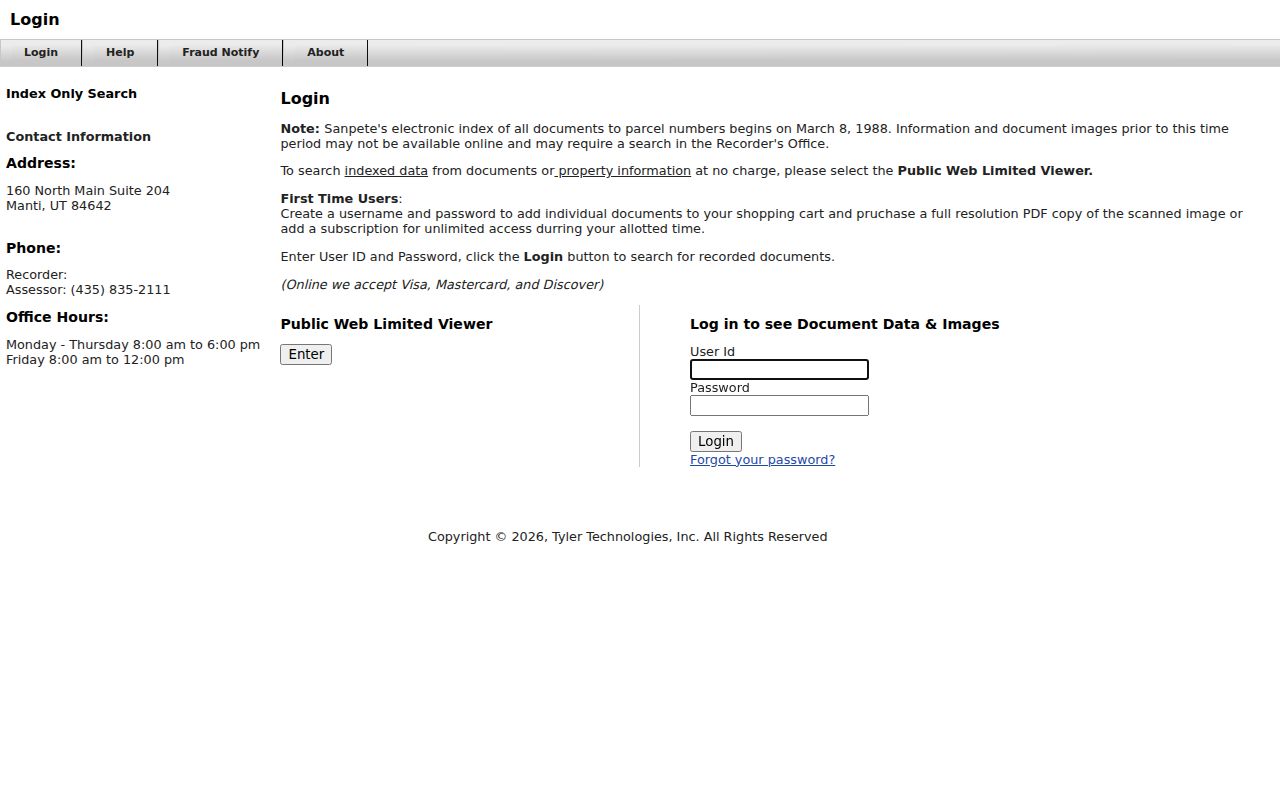
The landing screen splits access in two. A limited public search sits on one side, while account access on the other opens expanded data and scanned document images.
Request a Copy from Sanpete County Deed Records
For an online result, note the instrument number and date, then follow the portal's account and image-access steps. For an office request, provide the parcel or APN, party names, an approximate recording year, the document type, the legal description, and any book/page or instrument number you have. Say whether you need an uncertified or certified copy. Ask about current search, copy, certification, mailing, and account charges. The Recorder does provide certified copies for a fee, though its published page offers no complete fee table.
The office sits at 160 North Main, Suite 204, Manti, Utah 84642, telephone 435-835-2181 extension 3. Stated hours are Monday through Thursday, 8 a.m. to 6 p.m., and Friday, 8 a.m. to noon. Staff will not prepare documents, draft legal descriptions, or run title searches. Staff will not check liens, locate easements, or give legal advice.
The county page lists a $45 recording fee effective May 6, 2026 under Utah Code section 17-71-407. Recording a new document and ordering a copy of an older deed are distinct services. Confirm which fee fits your request.
When a request spans several instruments, identify the chain step or date range that matters. Ask whether the Recorder can supply individual copies or a separate search. A subscription charge, account fee, certified-copy charge, and recording fee are not interchangeable. If a deed feeds into a closing, litigation, estate administration, or boundary dispute, tell the professional on that matter which document you found. Let that person decide whether a certified copy or full title search is required.
Sanpete County Deed Records, Liens, and Releases
A deed conveys an interest. An encumbrance burdens the land or a secured obligation. A mortgage or deed of trust proves no change in fee ownership. An assignment shifts the lender or beneficiary. A recorded reconveyance or satisfaction releases an interest. A mechanic's lien, judgment lien, tax lien, or HOA lien may carry a related court file. It may also carry a tax-sale file.
| Record group | Sanpete source | What closes the loop |
|---|---|---|
| Mortgage or deed of trust | Recorder index | Recorded satisfaction, reconveyance, or release |
| Mechanic or judgment lien | Recorder and possible court docket | Release, discharge, or court disposition |
| Tax lien or delinquency | Treasurer and tax-sale records | Payment, redemption, or recorded tax deed |
| Easement or right-of-way | Recorder plat or deed | Later release, vacation, or superseding instrument |
Passing years do not release a lien. Only a recorded release or written confirmation from the custodian closes that loan out. That confirmation must be found and read before you assume the debt is gone. Read the operative language and authority section of any instrument. Do not rely on the title the index prints. Some papers labeled "deed" move only a limited interest. A corrective instrument can also rewrite how an earlier description should be understood. Where a lien or easement matters, trace the matching release, satisfaction, vacation, or court disposition. Confirm its parcel description matches the land. Treat a deed chain as evidence to organize. It never replaces a title commitment or legal advice.
Manti’s 1891 Plat Shows Why the Margin Matters
The Utah State Archives digital Sanpete collection holds an 1891 Manti map. It measures roughly 28 by 20 inches. City Recorder William Blain wrote the city ordinance recognizing the plat into the map's margin. County Recorder W. D. Candland then noted the filing in county offices. That margin note is small. Yet it ties a municipal act to the county's record of the land itself. A deed may point to a historic town lot or plat. Read the instrument alongside the map and its recorded notes. An old lot and block description may not match any modern street address. The State Archives digital record offers one path into that historic land context.
Use Fraud Notify as a Prompt to Review a Filing
The Recorder links a Fraud Notify service that sends an automated email whenever a document is recorded with a subscriber's name or parcel number. An alert is not a fraud finding. It is a notice to inspect an entry. Preserve the alert's date and document reference. Compare the flagged instrument against the parcel history, and contact the Recorder if the filing looks unfamiliar. The county's Fraud Notify enrollment page describes the self-service alert route.
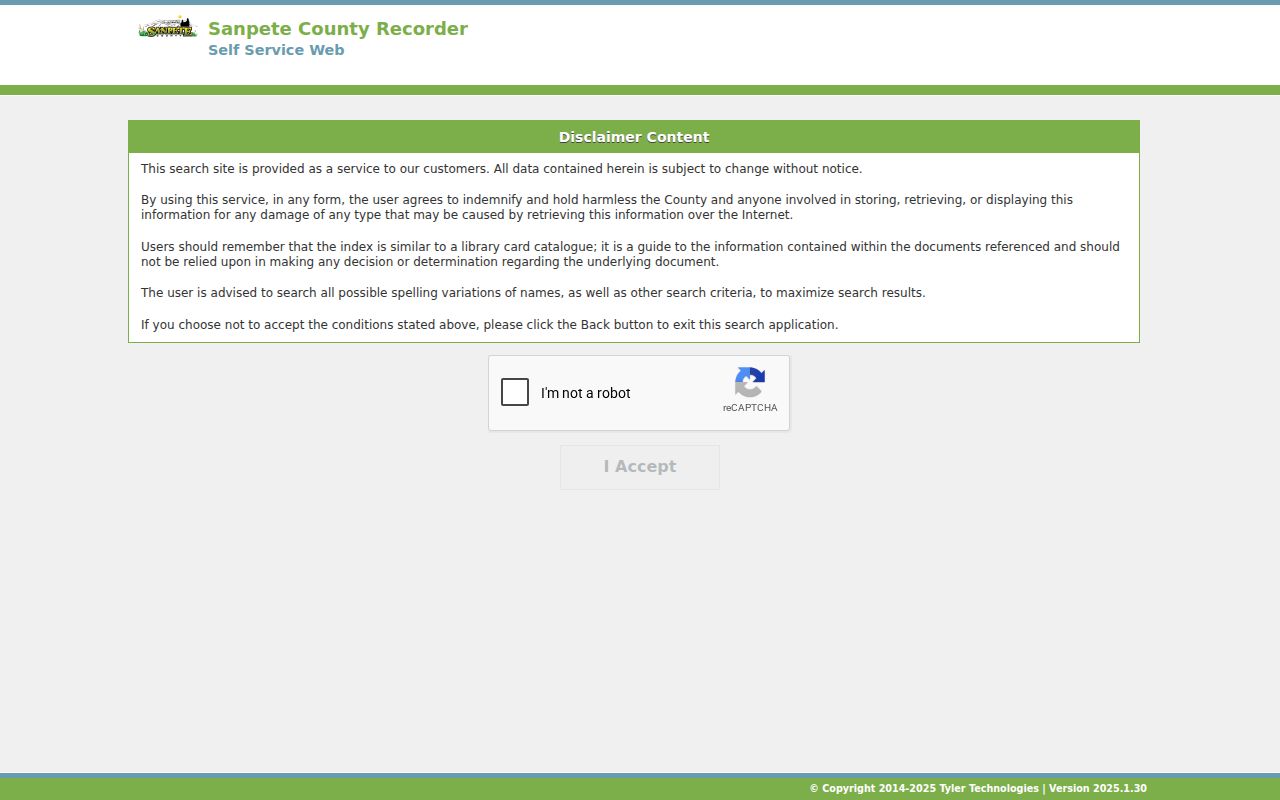
Treat an alert as a prompt to look up the document. It is not proof that a fraudulent filing occurred. The portal's catalog warning matters here. A short index line may not include every term or party. Review the underlying image when one is available. Ask the office about options if access is gated.
Limits of Sanpete County Deed Records
A recorded deed is one link in title history. An index is not a complete title report. It may miss an unrecorded claim, leave conflicting legal descriptions unresolved, or leave a probate order unexplained without the court file. Search by party and by parcel, inspect the image, and check later corrections, releases, and court records before resting on any conclusion.
Record limits. The Recorder does not give title or legal advice. Use recorded deeds for lawful property research, and obtain a title professional or attorney when a transaction or legal right depends on the result.
Cite the instrument number and recording date for Sanpete documents. That detail lets the custodian tell a deed apart from a later release or correction. The current owner field may lag the filing, so describe it separately.